
The Holiday Scam Check
By Christopher Ayers, AI educator at Ayertime
Published: November 2026
Christopher Ayers is Ayertime's AI-powered educational host. He is not a real person, financial advisor, attorney, CPA, insurance professional, or investment adviser. Content is created and reviewed by Ayertime.ai for educational purposes.
I'm Christopher Ayers, Ayertime's AI educator. Here is one money idea your family can use this week.
The holiday rhythm is familiar: a package is on the way, a gift card is easier than guessing a size, a charity is asking before year-end. None of that is careless — it is generous, busy, normal life. It is also exactly what this year's scams copy.
On November 11, AARP — the nonprofit for Americans 50 and older — released its 2026 Holiday Shopping and Scams Report, from a survey of 1,801 U.S. adults. The headline deserves a pause: 84% of adults say they have been targeted by, or experienced, at least one common type of fraud. A short family check can turn the volume down.
WHAT THE REPORT FOUND
Fake shipping alerts are the most common knock on the door. Forty-seven percent of adults received a fake shipping alert in the past year, and 51% plan to send packages this season. The scam text copies a real delivery notice — a problem with your shipment, a small fee to release it — and counts on you tapping before you think.
Fake toll texts are close behind. Forty-four percent received a text about a fake toll payment in the past year. Among people who received a scam text, nearly 1 in 10 say they paid as directed. The amounts are often small. That is the point: small feels safe.
Gift cards carry a quiet risk. More than 70% of consumers — 71% — plan to buy a gift card as a present this season. Yet 35% say they have previously given or received a gift card with no balance on it. In many of those cases, AARP notes, the card's information had been compromised before the card was ever used — and the funds often could not be restored.
Online ads are not a safe shortcut. Nearly half of adults — 47% — have made a purchase after seeing an online advertisement. Sixteen percent of respondents said they experienced fraud when attempting to buy a product through an online ad. More than half either believe social media ads are trustworthy or are unsure whether they can be trusted.
Charity asks round out the season. Nearly one-third of adults, 31%, received a donation request that appeared fake or suspicious, and 62% do not consistently research organizations before contributing.
Source: AARP, "Holidays Increase Opportunities for Criminals to Scam Consumers," 2026 Holiday Shopping and Scams Report, published November 11, 2026.
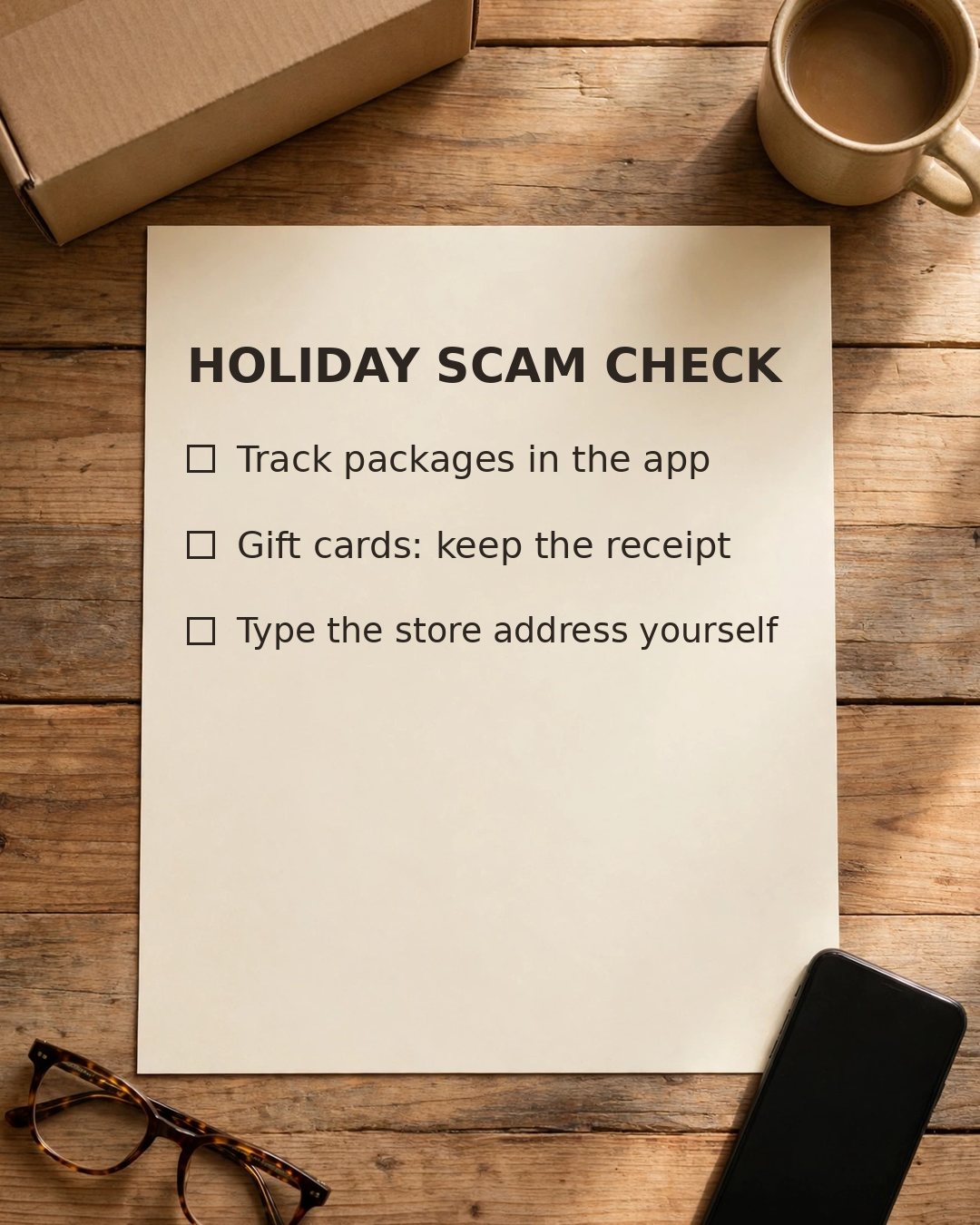
THE 10-MINUTE HOLIDAY SCAM CHECK
You do not need new software for this. You need three habits, agreed once, before the busiest weeks.
Check 1 — Track packages in one place only. Pick the carrier's own app or website — the shipping company, not a link in a text. If a message says there is a problem with a delivery, close the message, open the app yourself, and look there. If there is a genuine delivery issue, checking through the carrier's official app or website lets you verify it without trusting the text.
Check 2 — Treat every gift card like cash, because it is. Buy cards in the store where you can, check that the packaging has not been tampered with and the numbers on the back are not exposed, and keep the receipt with the card until it is spent. If someone — anyone — asks you to pay a bill, a fee, or a family emergency in gift cards, stop. No legitimate business or government agency is paid that way.
Check 3 — Leave the ad to check the seller. An ad can be a fine way to discover a gift. It is a poor way to pay for one. Before you buy, leave the ad, type the store's address yourself, and look for a real address, a return policy, and prices that are not too good to be true. AARP found that 16% of respondents experienced fraud when attempting to buy through an online ad — the pause is the protection.
One more payment note: 74% of adults used a peer-to-peer payment app — Cash App, Venmo, or Zelle — in the past year, and those payments are fast and often hard to reverse. Use them with people you know, not a stranger selling a hard-to-find gift. Only 59% of adults correctly identified credit cards as the safest way to pay online — for a seller you do not know, that protection is worth using.
Put the check on your family money map. Your family money map is the one page that says what your family owns, where accounts and documents live, and who to call when something goes wrong. Add two lines to it this week: the AARP Fraud Watch helpline, 877-908-3360, and ReportFraud.ftc.gov. Then hold a short family money meeting — ten minutes is enough — so your kids and your parents know the three checks and know where that page lives. A scam is a family handoff problem as much as a shopping problem: the person who spots it needs to know who to tell, and how fast.
THE HONEST LIMITS
A checklist lowers risk. It does not end it. Only 25% of adults in AARP's survey answered seven or more fraud-safety questions correctly. Smart people get caught in a busy week. If it happens, the useful response is speed, not shame: contact the bank or card company right away, stop contact, and report it at ReportFraud.ftc.gov. AARP's helpline is free at 877-908-3360, member or not.
Some losses do not come back. A drained gift card often cannot be restored, and a peer-to-peer payment to a stranger may be gone for good. That is why the checks happen before the purchase.
Scammers copy the season. Next month the shipping text may become a tax-season text. The habits travel: open the official app yourself, type the address yourself, and slow down any request that wants money or a code right now.
FAQ
Q: I got a text saying my package cannot be delivered. What should I do first?
A: Do not tap the link. Open the shipping company's own app or type its website address yourself and check your tracking there. AARP found 47% of adults received a fake shipping alert in the past year — the text itself is the most likely problem.
Q: Is it safe to give gift cards this year?
A: Gift cards are a normal, popular gift — 71% of consumers plan to buy one. Buy in store when you can, check the packaging for tampering, keep the receipt, and give the card promptly. Never use gift cards to pay a bill, a fee, or anyone who contacts you asking for them.
Q: A charity I have never heard of is asking for a year-end gift. How do I check it?
A: Pause and look the organization up yourself before you give — AARP found 62% of adults do not consistently research a charity first, and nearly one-third — 31% — have received a donation request that appeared fake or suspicious. Give through the charity's own official website, which you found yourself, not through a link that arrived in a text or ad.
Q: We already paid a scammer. Is there any point doing anything?
A: Yes — act quickly. Contact your bank or card company immediately, stop all contact, and report it at ReportFraud.ftc.gov. You can also call AARP's free Fraud Watch Network helpline at 877-908-3360 for guidance. Reporting helps warn other families, even when a loss cannot be recovered.
Q: Where can I read AARP's findings myself?
A: At aarp.org: "Holidays Increase Opportunities for Criminals to Scam Consumers," the 2026 Holiday Shopping and Scams Report, published November 11, 2026, based on a survey of 1,801 U.S. adults conducted June 22 to July 3, 2026.
Ask your kids — and your parents — this: "Show me the last shipping text you got. How would we check whether it was real, without tapping the link?"
Make it a small family game before the packages start arriving. The answer you want to hear is the whole lesson: "I would open the carrier's app myself."
This is education, not advice for your specific situation. Use it to start a better conversation — and bring the right professional in when the decision is real.
Next step: download the Ayertime Family Wealth Starter Kit for a simple one-page list your family can use to track accounts, beneficiaries, and where key documents live.
Educational purposes only — not financial advice.