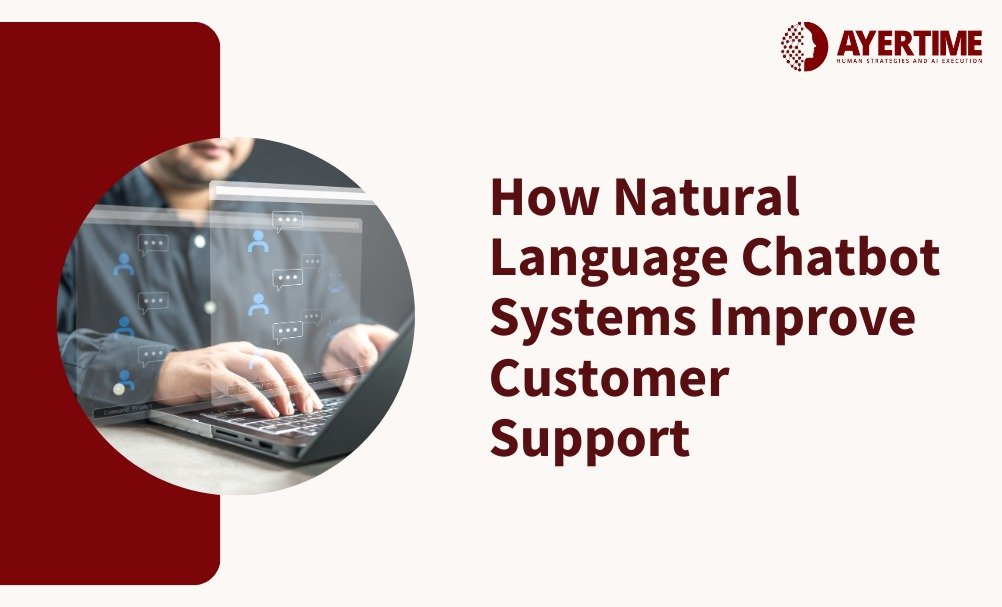
How Natural Language Chatbot Systems Improve Customer Support
We’ve all been there. You have a simple question about an order, so you open the chat window on a company’s website. You type your question, and the bot replies with a list of irrelevant options. “I didn’t catch that,” it says. “Please select from the menu below.” You try rephrasing, but the bot just loops back to the beginning. Frustrated, you end up mashing the “0” key, hoping to reach a human.
This experience—common with rigid, old-school technology is quickly becoming a thing of the past. We are entering a new era where customer service isn’t defined by robotic menus, but by intelligent conversation.
The driving force behind this shift is the rise of Natural Language Chatbot Systems. Unlike their predecessors, these advanced bots understand context, interpret slang, and decipher customer intent with surprising accuracy. They don’t just follow a script; they understand language.
This guide explores how these sophisticated systems are transforming customer support. We will look at how they differ from traditional tools, the tangible benefits they offer both customers and support teams, and how businesses can implement them to boost efficiency and satisfaction.
What Are Natural Language Chatbot Systems?
To understand why these tools are so powerful, we first need to define what they are. Natural Language Chatbot Systems are software applications capable of understanding and processing human language as it is spoken or written. They rely on two core technologies: Natural Language Processing (NLP) and Natural Language Understanding (NLU).
NLP allows the computer to read the text, while NLU helps it decipher the meaning behind that text, including sentiment and intent.
Versus Rule-Based Chatbots
The best way to appreciate this technology is to contrast it with what came before: the rule-based chatbot.
- Rule-Based Bots (The Old Way): These function like a digital decision tree. They are rigid and keyword-dependent. If a customer types a phrase the bot hasn’t been explicitly programmed to recognize, the conversation breaks. They require the user to speak “robot,” often forcing them to click buttons rather than type freely.
- Natural Language Chatbot Systems (The New Way): These are flexible and context-aware. They use machine learning to improve over time. You can ask the same question in five different ways (e.g., “Where is my stuff?”, “Track package,” “Shipping update?”), and the system understands that the intent is the same.
The Key Benefits for Customer Support
Adopting conversational AI isn’t just about using cool technology; it solves specific, painful problems in customer service.
24/7 Availability and Instant Gratification
Modern consumers are conditioned to expect speed. According to Hubspot research, 90% of customers rate an “immediate” response as important or very important when they have a customer service question.
Human agents have to sleep, eat, and take breaks. Natural Language Chatbot Systems do not. They provide instant answers at 2:00 AM just as easily as they do at 2:00 PM. This eliminates the dreaded “we will get back to you in 24-48 hours” email auto-responder, ensuring customers feel heard the moment an issue arises.
Handling Complex Queries with Context
One of the biggest limitations of older bots was their “goldfish memory”—they forgot what you said ten seconds ago.
Natural Language Chatbot Systems excel at context retention. They can remember previous parts of the conversation to inform current answers. For example, if a user asks, “I want to buy running shoes,” and the bot shows a selection, the user can then simply ask, “Do you have them in red?”
An old bot might get confused by the word “them.” An NLP-driven system understands that “them” refers to the running shoes mentioned previously. This capability makes the interaction feel like a genuine conversation rather than a data entry task.
Personalization at Scale
Because these systems can integrate deeply with your CRM (Customer Relationship Management) software, they can deliver personalized experiences that rule-based bots cannot.
Instead of a generic “Hello, User,” the bot can greet a customer by name: “Hi Sarah, welcome back.” It can access purchase history to make relevant suggestions or provide updates on a specific order without asking Sarah to hunt down her order number. This level of personalization makes customers feel valued rather than processed.
Improving the Human Agent Experience
There is a common fear that AI customer service tools are here to replace humans. In reality, the most successful support teams use Natural Language Chatbot Systems to empower their human agents, not remove them.
Ticket Deflection
Support teams are often buried under a mountain of repetitive Tier 1 tickets—questions like “reset my password,” “what is your return policy,” or “where is my order.” These questions are necessary to answer but tedious for a human to type out a hundred times a day.
Natural Language Chatbot Systems handle these routine inquiries automatically. This is known as ticket deflection. By resolving 40% to 80% of these simple queries without human intervention, the system clears the queue, allowing human agents to focus on high-value interactions that actually require empathy and complex problem-solving.
Agent Assist
These systems don’t just work on the front lines; they also work in the background. “Agent Assist” technology listens to live conversations between a human agent and a customer. It then suggests answers, pulls up relevant help articles, or retrieves data in real-time. This speeds up manual support significantly, as agents spend less time searching for information and more time helping the customer.
Reduced Burnout
Customer support has one of the highest turnover rates of any industry. A major contributor to this is the repetitive nature of the work. When agents spend their entire day copy-pasting the same shipping policy, engagement drops.
By offloading the mundane tasks to automated support agents, human roles become more engaging. Agents are challenged with complex issues that require critical thinking and emotional intelligence. This shift leads to higher job satisfaction and lower turnover.
Real-World Success Stories
This technology isn’t theoretical; it is driving results for businesses right now.
Consider a mid-sized e-commerce fashion brand facing the holiday rush. In previous years, their support team was overwhelmed by “where is my order” tickets from Black Friday through Christmas. Response times ballooned to three days. By implementing a natural language bot, they could instantly answer order status queries. The result? Customer satisfaction scores remained high during peak season, and the human team wasn’t burned out by January.
Similarly, a growing SaaS company used intelligent bots to tackle technical troubleshooting. Instead of waiting for an engineer to manually reset a license key, customers were guided through the process by the bot. This reduced their ticket backlog significantly, allowing their technical support engineers to focus on fixing bugs rather than administrative tasks.
The takeaway here is crucial: Natural Language Chatbot Systems are not just for enterprise giants with unlimited budgets. They are accessible, scalable tools that growing businesses can use to compete on service quality.
Implementation Best Practices
Ready to upgrade your support strategy? Here is how to implement these systems effectively.
Start Small
Don’t try to automate every single customer interaction on day one. Analyze your support data to find the top 5 to 10 most frequently asked questions. Train your bot to master these specific topics first. Once it is performing well, you can expand its knowledge base.
The Human Handoff
No bot is perfect. There will always be complex, emotional, or unique situations that require a human touch. The most critical feature of any chatbot deployment is a seamless transition to a human agent.
If the system detects frustration (via sentiment analysis) or cannot answer a question after two attempts, it should immediately offer to connect the user to a live person. This safety net prevents the frustration loops discussed in the introduction.
Continuous Training
These systems are “smart,” but they still need teachers. NLP technology thrives on feedback loops. You need a process where human agents review chatbot conversations to identify where the bot got confused. By feeding these corrections back into the system (Machine Learning), the bot gets smarter and more accurate over time.
Elevating the Standard of Service
The move toward natural language chatbot systems is not just about saving money or using new technology. It is about valuing your customer’s time and giving them a better experience. Today’s customers want quick answers that feel natural, clear, and helpful, not confusing menus or long wait times.
By using conversational AI instead of rigid button-based systems, businesses can offer support that feels more human. Customers get faster responses, more accurate help, and conversations that actually make sense. At the same time, human teams are freed from repetitive tasks and can focus on solving real problems and building stronger relationships.
If your support still depends on endless menu options or customers waiting on hold, it may be time to upgrade. A smarter approach can completely change how people feel about your brand. Want to improve your customer experience? Consult Ayertime today and see how natural language chatbot systems can work for your business.