
AI Customer Support Automation: Faster Help, Happier Clients
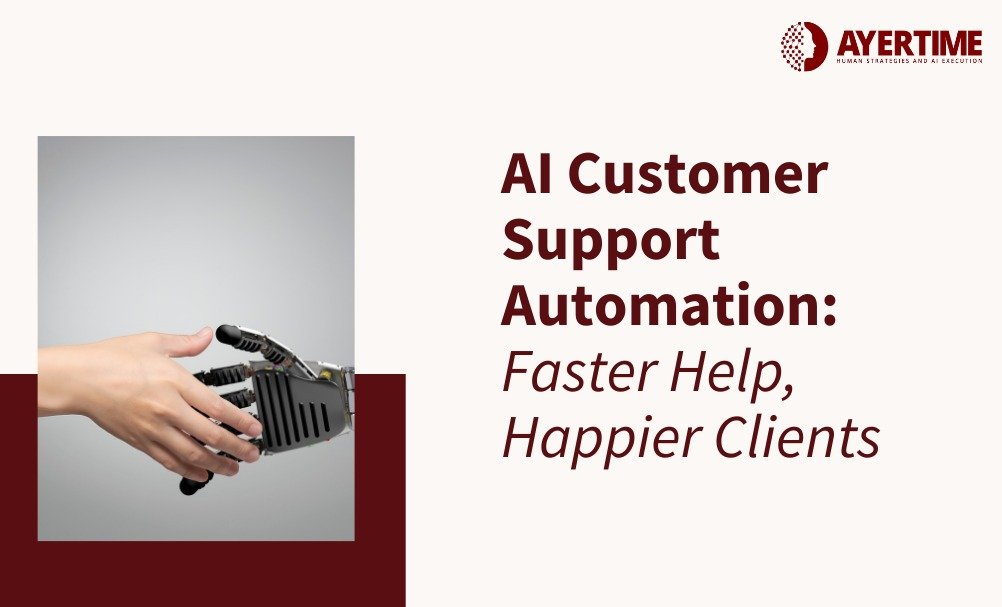
We have all been there. You are on hold, listening to a repetitive saxophone loop for forty-five minutes, just to ask a simple question about a refund. Or perhaps you sent an email on Friday afternoon and won’t hear back until Tuesday. It is frustrating, inefficient, and frankly, a relic of the past.
Modern consumers live in an on-demand culture. Whether it’s streaming a movie or ordering dinner, we are used to instant gratification. Why should customer service be any different?
This is where AI customer support automation comes in. It serves as the bridge between limited support resources and unlimited customer demand. In an era where 90% of customers rate an “immediate” response as essential for customer service, relying solely on manual support teams is a strategy set up to fail. Teams simply cannot type fast enough to keep up.
This post explores exactly what this technology is, how it delivers the triple threat of speed, scale, and savings, and provides a roadmap for implementing it without losing that crucial human touch.
What is AI Customer Support Automation?
At its core, AI customer support automation is the use of artificial intelligence technologies such as Natural Language Processing (NLP) and Machine Learning (ML) to resolve customer issues without human intervention.
It is important to differentiate this from the “dumb” chatbots of the early 2010s. Those systems relied on simple, rule-based automation. If a customer said a specific keyword, the bot spat out a pre-written link. If the customer used a synonym the bot didn’t recognize, the system failed.
True AI automation is different. It understands intent and context. It can decipher that “Where is my package?” and “I haven’t received my order yet” mean the same thing.
Common examples of this technology in action include:
- Intelligent Chatbots: Virtual assistants that can troubleshoot technical issues or process returns in real-time.
- Automated Email Triage: Systems that scan incoming emails, tag them by urgency and topic, and even draft suggested responses for agents to review.
- Self-Service Recommendations: Smart knowledge bases that suggest relevant help articles as a user types their question, often solving the problem before a ticket is even created.
The Triple Threat: Speed, Scale, and Savings
Implementing AI customer support automation isn’t just about adopting new tech for the sake of it. It offers tangible business benefits that solve the “impossible triangle” of support: fast, cheap, and good.
Instantaneous Responses
The most obvious benefit is availability. AI doesn’t sleep, take lunch breaks, or go on vacation. It operates 24/7/365. This means a customer in Tokyo can get help from a US-based company at 3:00 AM without the company needing to staff a graveyard shift. When a client has an urgent issue, getting an answer in seconds rather than hours prevents frustration from boiling over into churn.
Infinite Scalability
Human teams have a hard limit on capacity. An excellent agent might be able to handle three chat sessions at once, but four is pushing it. AI, however, faces no such limits.
Consider the chaos of Black Friday or a major product launch. Traffic spikes can drown a human support team, leading to burnout and missed tickets. AI customer support automation allows you to handle 1,000 inquiries just as easily as it handles 10. The system scales up instantly to meet demand without the need to hire, train, and manage temporary staff.
Cost Efficiency
While there is an initial investment in setting up these tools, the long-term financial impact is undeniable. AI dramatically lowers the cost per ticket. By automating Tier 1 queries the repetitive questions like “reset my password” or “what is your return policy” you remove the bulk of the volume from your expensive human payroll. This allows you to allocate your budget toward skilled agents who handle high-value interactions.
The “Hybrid Model”: AI + Humans
One of the biggest fears businesses have regarding automation is sounding robotic or impersonal. We crave human connection, especially when we are upset.
The most effective AI customer support automation strategy isn’t about replacing humans; it’s about empowering them. This is often called the “Hybrid Model” or the “Tiered Approach.”
- Tier 1 (AI): The AI acts as the first line of defense. It handles FAQs, order status checks, password resets, and simple troubleshooting. It clears the clutter.
- Tier 2 (Humans): Because the AI is handling the easy stuff, human agents are free to tackle complex, emotional, or high-value issues. They have the time to offer empathy and deep problem-solving skills because they aren’t bogged down by copy-pasting shipping links.
The key to success here is the “seamless handoff.” If the AI cannot solve a problem, it should instantly pass the chat to a human agent. Crucially, the AI should provide the agent with a summary of the conversation and the customer’s intent. This ensures the customer doesn’t have to repeat themselves—a major pet peeve for anyone seeking help.
Best Practices for Implementation
Ready to integrate AI customer support automation into your workflow? Here is how to do it right.
Start with Your Data
AI is only as intelligent as the information it is fed. If your internal documentation is outdated or messy, your AI will give bad advice. Before you launch a bot, audit your Knowledge Base. Ensure your articles are clear, up-to-date, and comprehensive. This content is the “brain” your AI will rely on.
Don’t Hide the Human
Nothing infuriates a customer more than being trapped in a loop with a bot that doesn’t understand them. Always offer an “escape hatch.” Whether it’s a button that says “Talk to an Agent” or the ability to type “Human,” make it easy for users to bypass the automation if they need to.
Monitor and Train
AI customer support automation is not a “set it and forget it” solution. It requires maintenance. You need to regularly review conversation logs to see where the AI is getting confused. Is it misinterpreting a new slang term? Is it giving an outdated refund policy? Regular auditing ensures the AI’s tone matches your brand voice and that its answers remain accurate.
The Future of Client Happiness
To recap, using AI customer support automation is one of the smartest ways to reduce response times, cut support costs, and let your human team focus on meaningful work. Instead of answering the same questions again and again, agents can spend their time helping customers with real issues that need care and understanding.
The real goal is not just speed or efficiency. It is customer happiness. In today’s competitive market, businesses that respect their customers’ time build stronger trust and long-term loyalty. Fast and accurate support makes people feel valued.
Getting started does not have to be overwhelming. You can begin small. Review your support tickets from the last month and list the five most common questions. Automating answers to just those can make a noticeable difference right away. Ready to improve your support experience? Consult Ayertime today and discover how AI customer support automation can simplify support and delight your customers.